
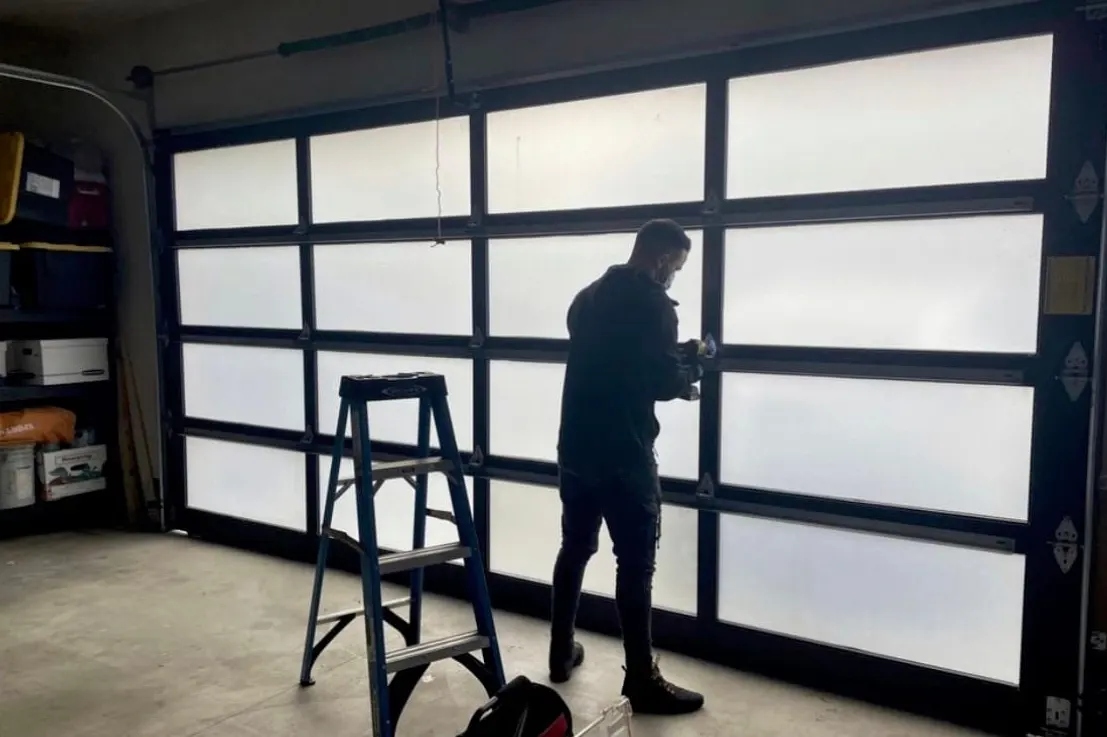
It usually happens on a Saturday. One of you is pulling the car out, the door groans on the way up, and someone says, "We really need to replace this thing." The other one says, "It still works fine, why spend the money?" Now you're standing in the driveway arguing about a garage door instead of going wherever you were going.
Here's the thing: you're both a little right. A garage door from the 1990s or earlier isn't automatically a hazard just because it's old. Some parts genuinely need updating for safety. Others are just old-fashioned and perfectly fine to leave alone. The trick is knowing which is which.
What actually needs to be retrofitted
The auto-reverse safety sensors
If your garage door opener doesn't have two small sensor eyes mounted a few inches off the ground on either side of the track, this is the one non-negotiable item. Openers made before the mid-1990s often relied only on mechanical force-sensing, which is slower to react and has failed in documented cases involving children and pets. If you don't see those sensor eyes, or they're there but don't light up, the opener needs to be replaced or retrofitted with a sensor-equipped unit. This isn't a "nice to have." It's the difference between a door that stops on contact and one that doesn't.
Springs without a safety cable
Older torsion spring setups sometimes lack a safety containment cable running through the spring. If that spring ever snaps under tension, it can whip violently instead of staying contained. A technician can add the cable without replacing the whole system, and it's a relatively small job for the protection it buys.
Exposed bottom brackets and worn fingers-near-the-track spots
Pre-code doors sometimes have open bottom roller brackets at pinch-point height, which is how fingers get caught during manual operation. Shielded brackets are an easy retrofit and worth doing if you have kids or grandkids in and out of the garage.
The wall-mounted control button
If your wall switch is a simple push-button with no keypad lock and sits low enough for a toddler to reach, consider a modern wall control with a lockout feature, especially if the garage opens into a mudroom or kitchen area where kids come and go.
What's fine to leave alone
The cosmetic condition of the panels
Faded paint, a few dents, slightly mismatched weatherstripping color — none of that is a safety issue. It's an appearance issue. If the panels aren't cracked, warped, or letting daylight through at the seams, there's no safety reason to replace them.
A manually-operated lock
Some older doors have a simple slide lock or T-handle lock instead of anything electronic. As long as it still engages fully and the door doesn't rattle loose in wind, this is a style choice, not a hazard.
Older-style wood or steel without added insulation
An uninsulated door isn't dangerous. It costs you more on heating and cooling, and with our hot, humid summers it can let more heat radiate into an attached garage, but that's a comfort and efficiency trade-off, not a safety one. Insulate if you want lower utility bills or you're finishing the garage into living space — not because you feel like you have to.
A slower-closing or slightly noisier motor
If the motor is louder than a newer one or takes a beat longer to engage, that's wear, not danger, as long as the auto-reverse function actually works when tested. Noise is annoying. It's not the same thing as unsafe.
Why the climate here changes the math a little
In this part of Georgia, humidity and heavy rain accelerate corrosion on springs, hinges, and track hardware faster than in drier climates. Pine pollen and moisture buildup around garage openings also gum up rollers and tracks, which can make an old door feel more dangerous than it is, when really it just needs cleaning and lubrication. Before assuming a retrofit is needed, rule out simple maintenance: a door that's sticking, grinding, or reversing unpredictably because of rust or pollen buildup on the track will often behave normally again after a real cleaning and adjustment. Occasional ice storms also stress old weatherstripping and can make doors harder to seal, which is a weather problem, not a structural one.
A simple way to settle the argument
Ask three questions. Does the opener have working sensor eyes? Does the spring have a safety cable? Are the bottom brackets shielded? If the answer to any of those is no, that's the retrofit conversation. Everything else — the color, the noise, the slightly dated hardware — is personal preference, not a safety case.
When to call College Park Garage Door
If you've checked those three safety points and aren't sure what you're looking at, that's exactly the kind of visit we handle regularly for homeowners from College Park out through East Point, Hapeville, and Forest Park. We'll inspect the opener's safety reversal system, check whether your springs need a containment cable added, and tell you honestly whether you're looking at a simple Garage Door Opener Repair & Installation or whether the door itself has reached the end of its safe service life. For older doors with worn tracks, pollen-clogged rollers, or hardware that's rusted from years of humidity, our Garage Door Maintenance service often resolves what looks like a bigger problem.
If you're in College Park, GA or nearby and you want a straight answer about what your old door actually needs, give College Park Garage Door a call. We'll tell you what to fix, what to skip, and settle the argument for good.